One score you can act on
Body Score puts seconds, kilos and centimetres on the same 0–100 scale. It never appears without the group it was measured against, so a 68 always comes with who that 68 is being compared to.
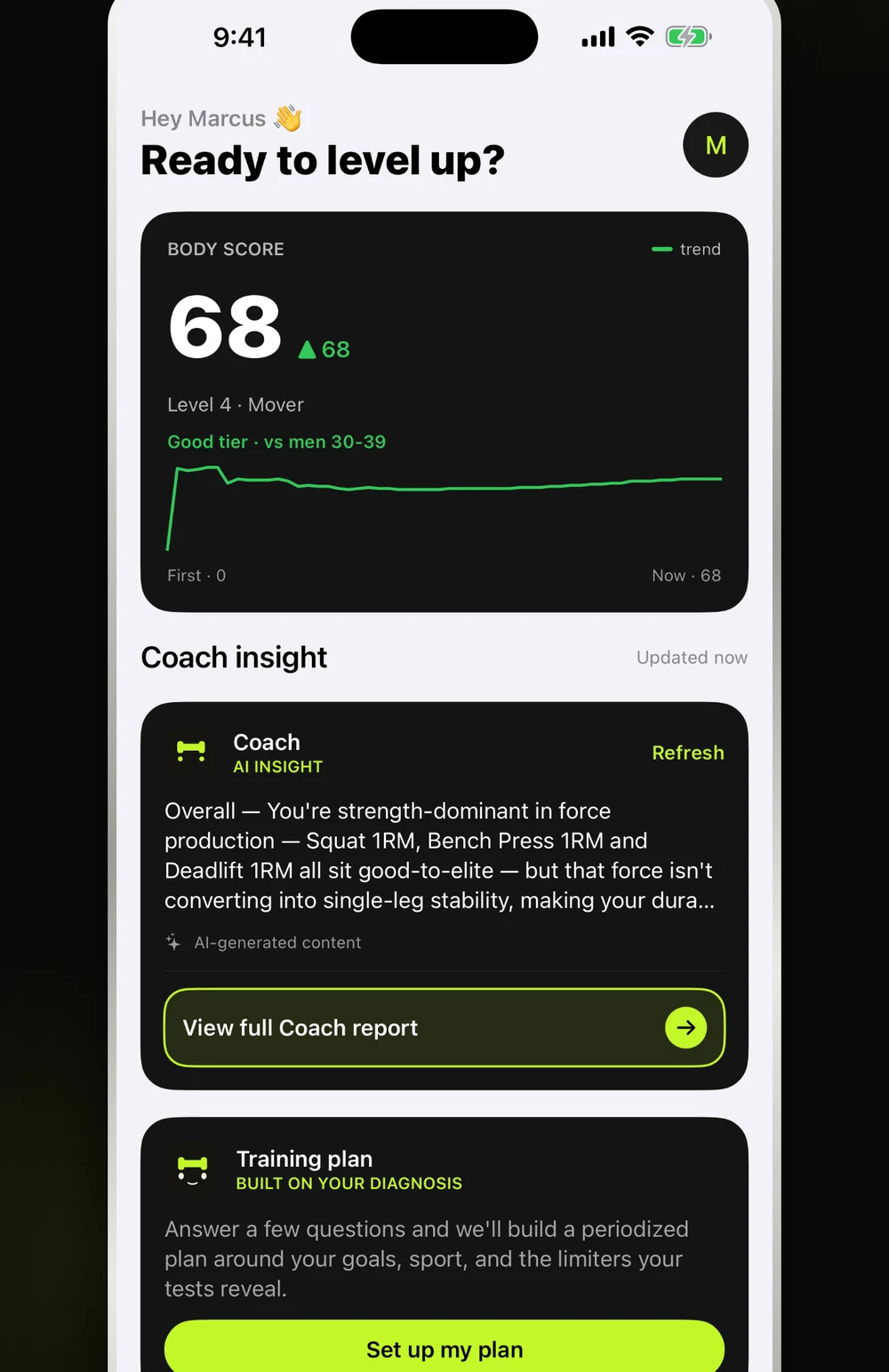
Pro teams measure every quality that decides performance — power, mobility, control, the engine — and train to keep them in balance. You've trained for years and never been measured once. Ten minutes on your iPhone scores all ten. Then a plan that brings them up together, so the strength you already have shows up when it matters, and there's no weak link left for an injury to find.
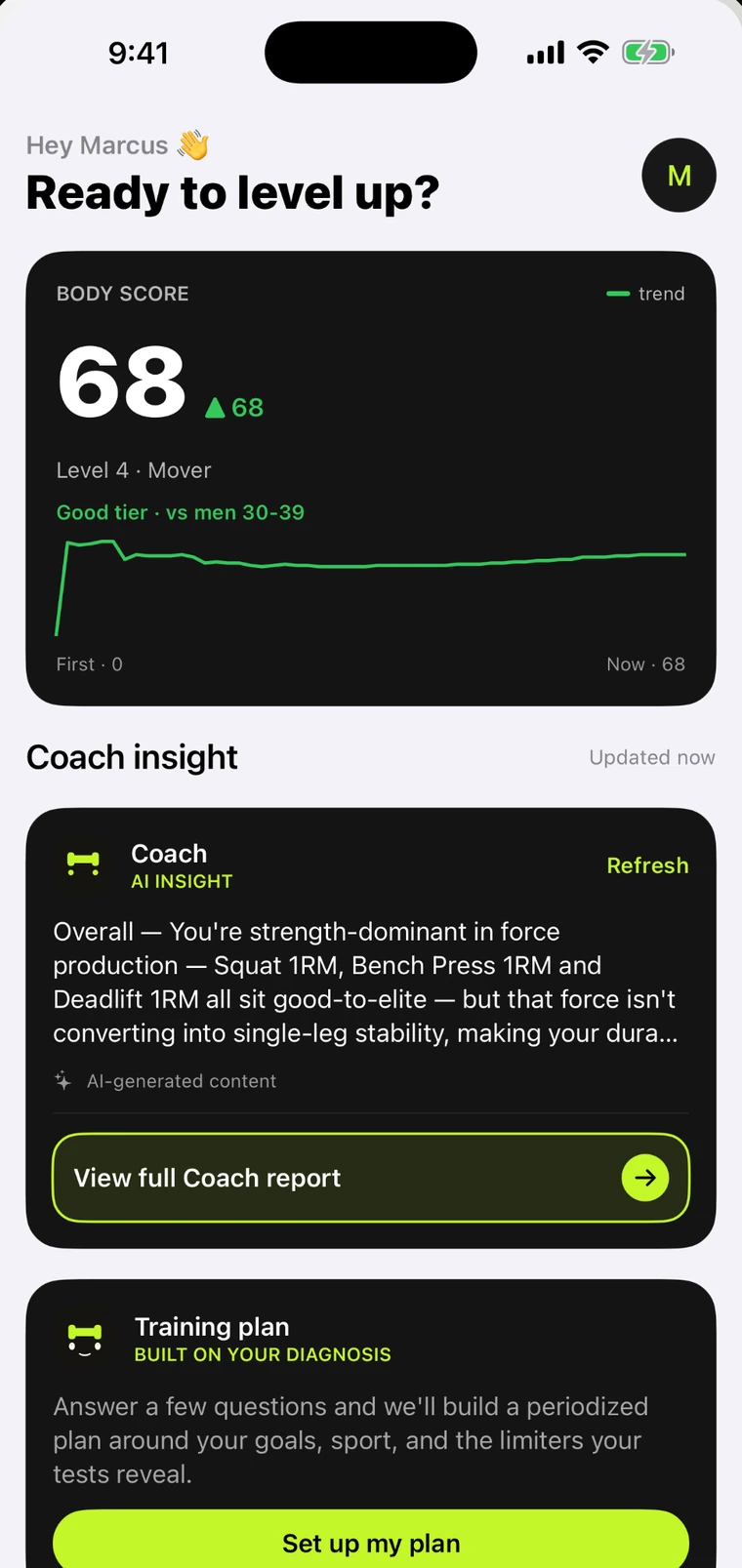
BodyBench starts by measuring what your body can do. Every plan that follows is built on that, instead of on your answers.
They ask what you want. We measure what you've got.
Recovery is half the story. What can you actually do?
Logging isn't testing. A PR log can't tell you your weakest link.
Not a lab in your pocket — a lab you'll actually use every four weeks.
These are screenshots, not mockups. Real scores from a real dataset, with the reasoning left in.
Body Score puts seconds, kilos and centimetres on the same 0–100 scale. It never appears without the group it was measured against, so a 68 always comes with who that 68 is being compared to.
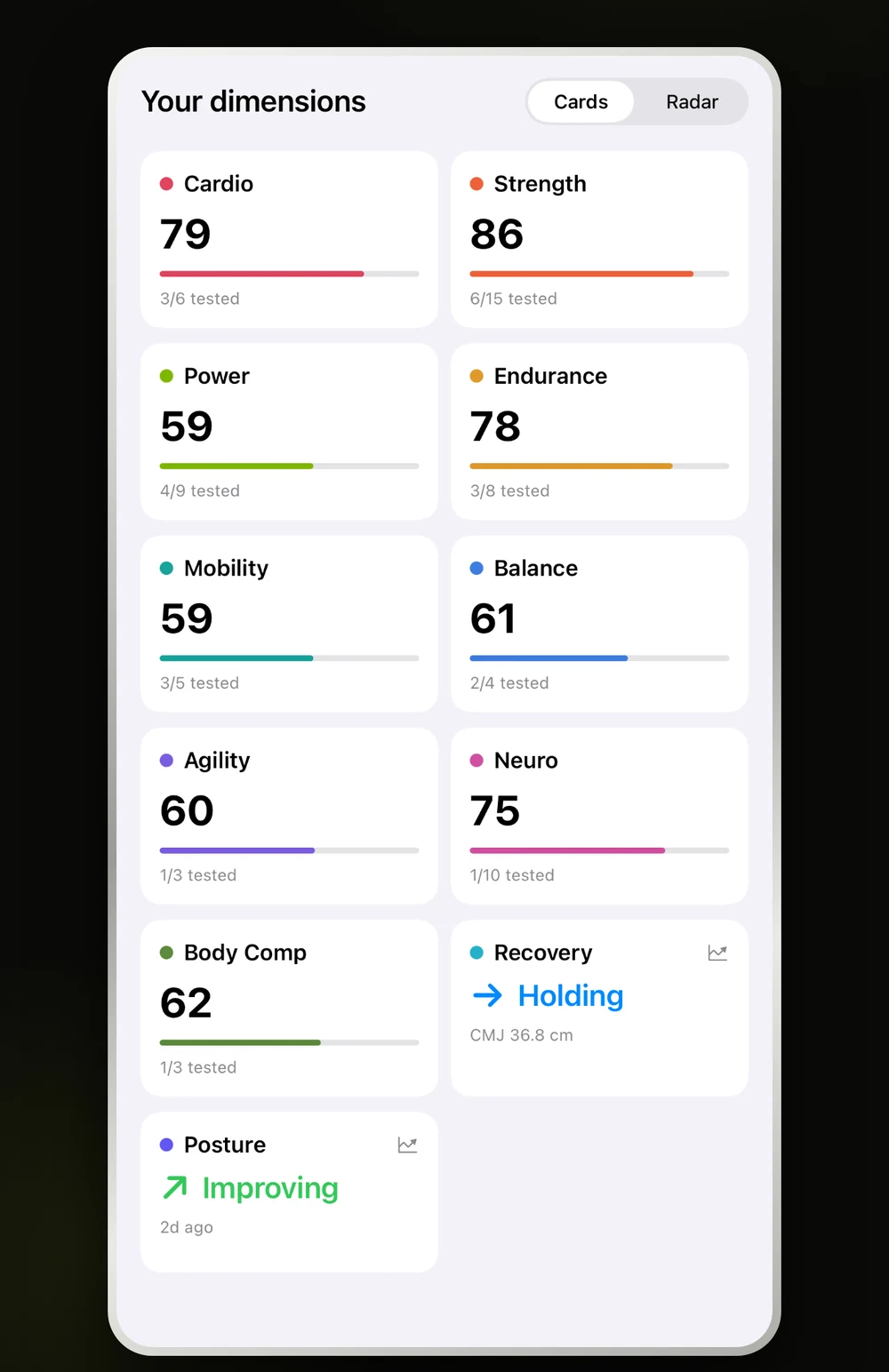
Each dimension shows how much of it you've actually tested. A 79 built on 3 of 6 tests isn't the same as a 79 built on all six, and the card tells you which one you're looking at.
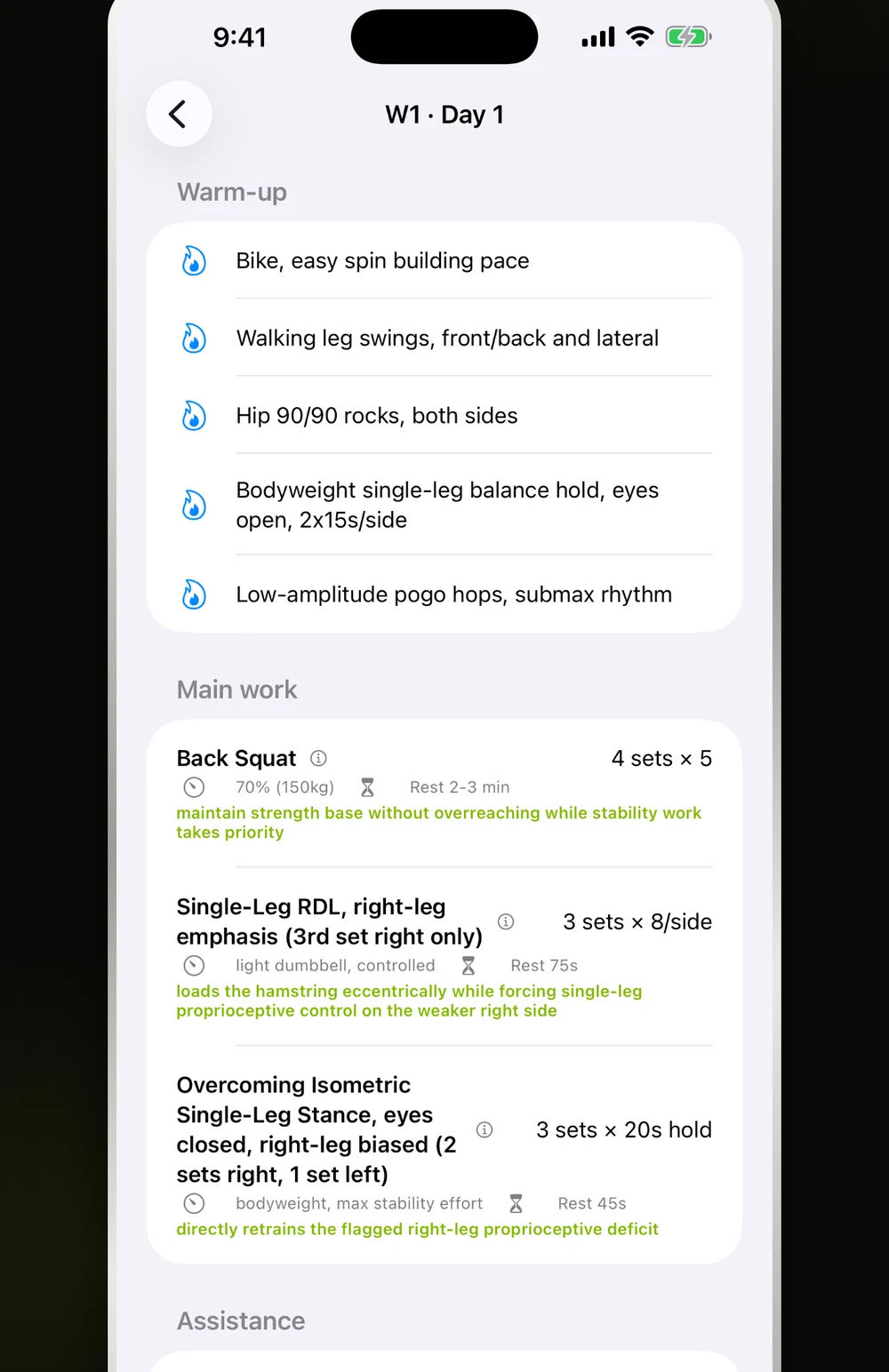
Each movement in the session says which limiter it targets, in one line, before you start it. If you can't see why an exercise is there, it shouldn't be there.
Each four-week block sits inside a longer plan that carries its own numbers: single-leg gap under 10%, EUR from 0.98 to 1.05, squat 1RM 213 → 220kg. You can read what month four is supposed to look like before you start month one.
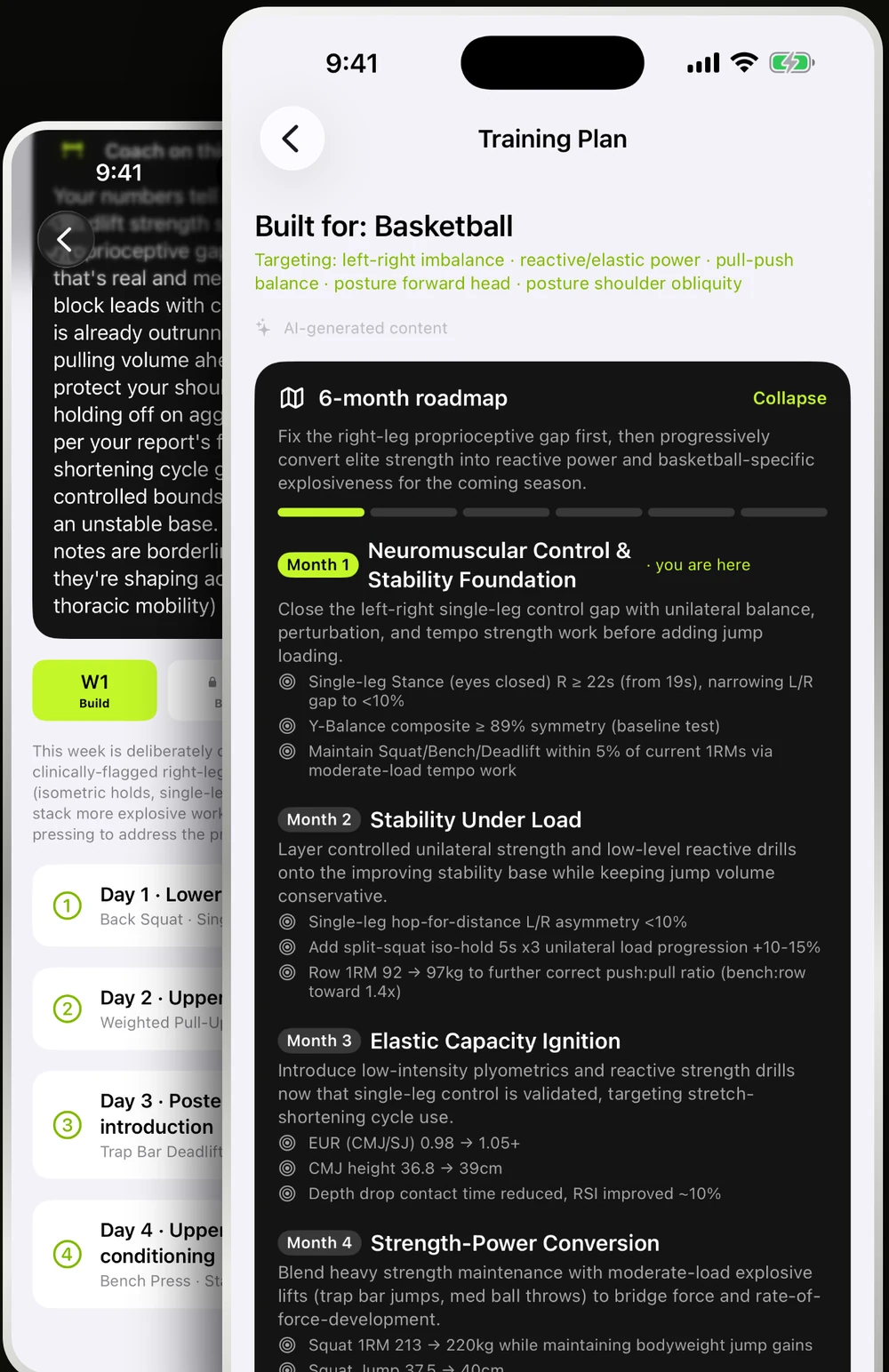
Every reading starts from a deterministic mechanism layer, not a hunch. Coach explains what the data shows and turns it directly into next week's training.
Deterministic mechanism layer. AI narration. No invented data.
One free Coach report is included — no card, no commitment.
Download on the App StoreEach test is scored against real population norms for your age and sex, then normalized into one 0–100 Body Score. Seconds, kilos and centimetres finally become comparable.
Posture is screened separately as an eleventh dimension and deliberately kept out of the Body Score. It's a flag to act on, not a number to average away.
Four weeks after Coach names your limiter, it asks you to retest that same dimension and shows you whether the block moved it. A plan that can be proven wrong is the only kind worth following.
The retest is built into the plan, not a separate step you have to remember.
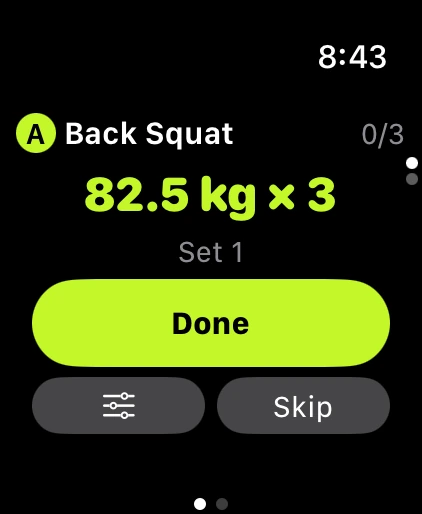
Download on the App StoreTap Start on iPhone and the session is already on your Apple Watch — every set, every load, every rest. Log a set with one tap, feel the rest timer on your wrist, and the whole workout lands in Apple Health with the effort score you gave it.
BodyBench isn't a step counter, and it isn't trying to be your whole fitness life. It answers one question well: what should you work on next, and how do you know it worked.
Your weight and your measurements still move, but you can't say whether you got stronger. Find out which mechanism is capping your lifts (asymmetry, reactive strength, something else) instead of adding volume and hoping.
Hyrox, five-a-side, a half marathon, a Sunday league. You don't have a physio and a strength coach on staff, so test before the season and after it and see what the training changed.
Track left-right gaps and mobility trend over time, and let the plan gate exercises around what's still healing. These are estimates for training guidance, not a medical assessment.
Test results, training history and meal logs are stored on your phone. There is no server-side copy. When you tap to request an AI reading, a plan, or a meal or posture analysis, that one request goes through our backend to a third-party AI provider and the answer comes back. We don't store those requests, and nothing is sent to us in the background.
The one thing that runs on its own is the iCloud backup, so a reinstall or a new phone doesn't lose your history — and it goes straight from your phone to your own private iCloud, never through us. On by default, off whenever you want.
All 10 dimensions and every test stay free, with one free Coach report and no card required. Exact pricing is set in the App Store and shown before you subscribe.
| What you get | Free | Coach |
|---|---|---|
| All 10 dimensions, 68 metrics | ✓ | ✓ |
| Body Score with tier and calibration group | ✓ | ✓ |
| Retest reminders every four weeks | ✓ | ✓ |
| Coach report naming your #1 limiter | One free | Unlimited |
| Periodized 4-week training blocks | — | ✓ |
| 6-month macrocycle roadmap | — | ✓ |
| Plans built from your tested 1RMs | — | ✓ |
| Meal photo analysis | — | ✓ |
| Posture insight from photo and skeleton angles | — | ✓ |
| Plans that adapt to how a session felt | — | ✓ |
Subscriptions auto-renew unless cancelled at least 24 hours before the end of the current period. Manage or cancel anytime in Settings › Apple ID › Subscriptions.
A 10-minute baseline assessment, free to start. No account needed.
Download on the App Store